Saturday, 26 September 2015

INTERVIEW-4

SIEMENS

Name
Prasad Hadawale

Branch
Electrical

College
Sardar Patel College of Engineering

Company
Siemens

Month and year of interview
9/14/2015

Company profile
Siemens is active in various diverse fields such as Electrical Machinery, Transformers, Automobiles, Electronics, Automation, Railway locomotives, Healthcare etc. It is a core & dream company for every electrical engineer.

Group Discussion Topic
No G.D. was taken.

Technical Round
1) How power flows from generating station to the room in which we are sitting? (Single Line Diagram is Expected)
2) SLD is 3 phase but power we are getting is 1-phase, so how?
3) Which motor is used in conveyer belt?
4) Earlier locomotives were D.C. but today we use A.C. which is better?
5) Difference between A.C. and D.C. systems.
6) You have done project named 'Digital Energy Meter' what you did in that? Such meters are available recently what different or special was there in your meter?
7) Have you participated in any competitions in college festival?

HR round
1) What is your hobby?
2) Family Background.
3) Which department you would like to work? Sales, manufacturing, etc.
4) Any location problem? Will your parents allow to work away from your home?


Any advice
Aptitude Test :Online
Slightly tough and every question has time limit.
   
Ø      Numerical: you have to find out and process numerical data from big table filled with data.
Ø      Verbal: Concluding in one line about the given passage, finding synonyms of certain words from passage
Ø      Logical: Figure matrix is asked only.

Technical Aptitude: Online and Easy
      Basic Knowledge is tested from subjects of Basic electical ckt.,D.C. Machine,Control systems.

Tuesday, 8 September 2015

INTERVIEW-3

INTERVIEW-3


Thyssenkrupp


        Here is one more addition to the interview experience series on this blog consisting of interview details of core engineering companies. This time it is the same company on which the previous interview experience was posted i.e. Thyssenkrupp.This series of post's will be helpful for those who plan to apply for a core company.

Name
Ajinkya P. Gorde

Branch

Electrical

College

Sardar patel college of engineering

Company

Thyssenkrupp

Month and year of interview

8/25/2015

Company profile:

The job will entail detail engineering activities such as preparation of Load list, Motor list, Single Line Diagrams,specification for electrical equipment like motors, transformers, etc., protection and control schemes, lighting layout and earthing layout for plants in India and abroad. Exposure to national and international standards will be provided. The role involves technical bid evaluation, inspection, and supervision of erection and commissioning of plants.
It is as per companies’ job description.

Group Discussion Topic:

"Shall we allow only tax payers and students to vote in elections".

Technical Round:

1. What should be the winding type for low voltage induction motor & why?
2. Same question for high voltage induction motor.
3. Which parameter should we consider while purchasing transformer?
4. What is the importance of impedance in transformer?
5. What are the different types of cooling technique used in transformer?
6. Role of capacitor in transmission line.
7. How reactive power is compensated by capacitor?
8. Types of circuit breaker & ratings of each.
9. Which circuit breaker should be used for hv & lv?

 10. Difference between contactor & circuit breaker.

HR round:

1. Introduce yourself.

2. Any information about ThyssenKrupp.

3. Which location you will prefer for job (Mumbai or Pune).

4. Future plan about higher studies.

5. They asked me about e-yantra competition,in which my group was in top 5 team, normally questions were like, what I learnt,total time & all about competition.

Any advice:

This company is fully technical hence be prepared. Don’t use same philosophy for all interviews. Try to get some information (interview question, technical aptitude & general aptitude weightage ) about company from seniors. Some information about company should be known.
 if you have studied only one subject, then it is OK but all concepts should be clear.
All the best.

I would like to thank Ajinkya for giving his precious time!!


Thursday, 3 September 2015

INTERVIEW-2


ThyssenKrupp


                                 Here is one more interview experience for your reference,this time it is "ThyssenKrupp"  a German multinational conglomerate corporation based in Duisburg and Essen, Germany. The corporation consists of 670 companies worldwide.

Name 
Pranil S Ugale

Branch 
Electrical

College 
Sardar Patel College of Engineering

Company 
ThyssenKrupp

Month and year of interview 
8/25/2015

Company profile 
It is a core company for electrical engineering.
A full range of specialist engineering and construction services and a ship-building history stretching back centuries are the strengths of Industrial Solutions. High-quality engineering is at the center of their success. Global project management skills, first-class system integration expertise, reliable procurement and supplier management, and a service offering meeting the highest standards form the basis for lasting customer satisfaction. They combine their plant engineering and construction expertise to offer the customers even more: Engineering Excellence. Basically it is not related to single area e.g. Oil and gas. But they are working in diverse areas from elevators to aircraft and from oil and gas industry to renewable energy sources.

Group Discussion Topic
 "Shall we allow only tax payers and students to vote in elections".

Technical Round 

1) Difference between circuit breaker and contactor.
 2) What comes to your mind after hearing EHV.
(basically full form and ratings are expected from you)
 3) Which configuration of primary and secondary winding for step down transformers will you use and why? 
4) Approximate ratings of step down transformer.
(ans: 6.6/0.415 kV, 3MVA & 8% impedance ) 
5) approximate Ratings of motors at HV load and LV load ,generator ratings at HV side 
(e.g. 6.6 kV, 8.4MW, 0.8 pf lag.)
6)If I cut 3 phase cable what will be the internal structure? 
7) similarly what you can see inside a conductor cable.

HR round 
1) Introduce yourself.
2) They will ask about your family background. 
3) From where you came to know or heard about ThyssenKrupp?
 4) In which area ThyssenKrupp is working? 
5) What are your higher education plans? 
6) Which location you will prefer for job (mumbai or Pune)

Any advice 
The company is looking for the technical knowledge of the person. If you have self confidence and know about company little you can easily complete HR round.If you have any internship or project prepare on it properly. Have basic knowledge of Ratings of switchgears, generators, transformers etc. All the best!


Monday, 24 August 2015

INTERVIEW-1


---------------------------------------------------------------------------------------------------------------------------------

Here is the experience of a person who actually appeared for L&T interview and have been
placed successfully . 
  
Name
Anjali Thorat

Branch
Electrical

College
sardar patel college of engineering

Company
Larsen & Toubro Limited

Month and year of interview
7/25/2015

Company profile

L&T is a core company.It is US $ 15 billion company & is engaged in Oil & Gas , infrastructure , power sector , Process industries , defense & heavy engineering. Infrastructure sector consists of mono rail/metro rail , large bridges & highways , airports etc. Recently new international air port at Mumbai i.e. Terminal 1 is built by L & T. Besides this , it is also in real estate sector. Apart from these , L & T is also in the business of IT & financial services .


Group Discussion Topic

Group discussion topic was "Is democracy hampering India's growth?"

Technical Round

The interviewer asked me my favorite subject and topic. On that basis the further questions were asked. 
1. Draw the equivalent diagram of transformer and explain what each element in the circuit represents? 
2. Draw the phasor diagram for transformer circuit. 
3. If we want to increase the efficiency of transformer what will you do?
4. How can you decrease iron losses? 
5. What is saturation? 
6. Tell about the different types of motor? 
7. In squirrel cage motor, rotor has 34 bars out of which 2 bars are broken . How is it going to affect the performance of the motor?

HR round

Hr interview: They first asked me to introduce myself. Then after all the technical questions, then started with HR round. They asked me in which area ( operation, projects, designing etc) I m interested in working and why? I answered that my area of interest is projects and gave my reason. 
     Then the interviewer gave me situation that if I was travelling from Mumbai to Assam for my project and I have to reach in two days. but on my way ,all my luggage gets stolen in Bihar. Interviewer asked me to consider him as TC and asked me to convince him my situation and make sure I reach my destination on time.


Any advice

There are few important things: 
1. Know well about the company and companies ongoing projects. 
2. Be well prepared with common HR questions. 
3. Be truthful. Don't fake yourself ,as interviewer can easily catch it.

Hope this help's you.

PLACEMENT'S


 Hello everyone,

         
             I first thought of creating this page when i spent days searching the net for some detailed information on interviews and the placement procedures of the companies that were going to visit our college campus  for placements ,but  i failed to get a good source of information available on the net about interviews and campus placement procedures conducted by core ELECTRICAL companies .So on this page you will find interview information of most of the core companies related to  ELECTRICAL engineering field.

------------------------------------------------------------------------------------------------------------------------------------------------------------------------------------------------------------------------

 The first company about which i am going to tell you about is:


   Yes this is dream company for many fresh electrical engineers including me, and now we will have a look at the placement procedure of this company.

  The company recruits many engineers every year through campus placement drives conducted in reputed colleges across India as "GRADUATE ENGINEER TRAINEES".

   The placement procedure goes as follows(may have minor changes which will be mentioned):

   1. Aptitude test(general and technical) : 

The aptitude test is the elimination round from which approximately only 40 to 50% candidates are selected for further rounds.
The general aptitude is generally long having basic sections like VERBAL,LOGICAL,NUMERICAL,the duration of the test is 60 min(may change) having nearly 20-25 questions in each section so nearly 60-70 question in all.

The technical aptitude is concepts based consisting of core topics from your 3 years of engineering syllabus

Major topics to be prepared for:
Basic Electrical engineering concepts(star-delta transformation, RMS concept of current and voltage,AC circuits etc)
Machines:This is most important topic but not everything is important from placement preparation point of view focus on topics like 
Transformer(Hysteresis and eddy current losses,efficiency,ratings of transformer and equivalent circuit etc)
Induction motor(Go through concepts of synchronous speed,slip,torque characteristics and different starting methods in both 3-phase and ,1-phase etc.)
besides this all go through concepts of Dc machines(types of dc motors/generators etc) and synchronous machine.

Power system: another important topic,but very vast so study selected topics like 
per unit system,faults(types and fault current levels),Circuit breakers(types and ratings),concepts of earthing and neutral and there effect on system,insulation grades with temperature ranges etc.

topics like control system,emf,micro-controllers are not asked generally as they want to test your core subjects knowledge

point to remember: test has a sectional cut off so be prepared for each section equally ,every section is important and you need to cross the cutoff in each section.

where to prepare from: 
General aptitude: No special book for preparing as such, because the test is basic so be clear with the basics, you can refer any aptitude book for this.

Technical aptitude: There are many book available you can refer your old engineering book they are more then sufficient,i would list some of them like
P.S.Bhimra or J.B.Gupta for machines,C.L.Wadhwa or Nagrath kothari for power system and Badriram for protection ,for Basics you can refer B.R.Patil.(this were the books i referred you may refer any other book you feel comfortable understanding)

so hope you find the above information useful and be successful in clearing this round and now lets have a look at the next round

 2.Group Discussion(G.D) : Chill!!! this is not a elimination round but there is weightage for this round as well which will be considered further so give your best shot.

In the next post i will post experiences of some people who have actually appeared for L&T interview and have been successfully placed.

Tuesday, 14 July 2015

E-YANTRA

This was the report we prepared for our e yantra competition hope you find it useful 

e-Yantra
Robotics Competition

State the scope of the theme assigned to you.

A seed sowing robot is an autonomous seed sowing machine as its name
implies .due to the increasing population the land available for agriculture is
rapidly diminishing, thus reducing the agricultural productivity. Today it has
become necessary to increase the agricultural productivity of India, to meet the
increasing demand of the ever increasing population 
      In the recent years the green house concept has emerged as a faithful
alternative for Indian farmers, where plants are grown in a controlled
environment suitable for them thus increasing the productivity.
The drawbacks of manual seed sowing in a green house are
• Increased time consumption
• Decline in the rate of production
• Wastage of precious seeds

Thus the basic remedy for this is the automation of the seed sowing process, and
thus building an autonomous seed sowing robot is the primary and most
important step in automation of this process.

Building Modules:

Identify the major building blocks in the robotic system that needs to be
designed for your theme. 

• Sensors: sharp IR range sensors, black line sensors
• Actuators: DC motors, servo motors.
• Power supply
• Signal conditioning  unit(ADC etc)
•  processing unit

Actuators:
              
List all the actuators currently present on FIREBIRD V robot and also the
essential actuators required for designing the robotic system in your theme.
A seed sowing robot requires the following list of actuators for its specified
task
Available on firebird
• Servo motor (0-180’ rotation): required in the mechanism for
controlling the position of the sensors.

• DC motors: required for primary motion of the robot along the arena

External Actuators:
• Servo motors(0-360’ rotation) : required in the mechanism for rotation
by a specific angle for dropping a single seed at a time

Explain the mechanism for controlling the actuators on your robot.

• Servo motor(0-180’ rotation): this servo would be used to exactly orient
the nozzle above the hole detected in order to prevent dropping it
outside the hole
•  DC motors: there motion would be controlled depending on the line
sensor reading
• Servo motors (0-360’ rotation): they would be rotated by a specific
angle to drop the required number of seeds in the hole. like for dropping
1 seed a rotation of 45 degree is rotated.

Environment sensing
Explain the functioning of environment sensing technique used by FIREBIRD V
robot in your theme.

• Line sensors: help the robot move across the arena along the line.
The three line sensors give different reading on black and white surface as
white reflects all of the light incident on it while black absorbs the light
incident .a program can be written depending on this values of the sensors
such   that  the   robot  moves  along  the  line  and  self  orients  itself  when   it
deviates from the line.

• Sharp IR range sensors: Depending on the values of the IR range sensors
the operation of the different actuators can be controlled. IR range
sensors give the distance of a surface depending on the angle of
reception of the light and thus are more accurate than ordinary range
sensors which give distance depending on the intensity of the received
light.

• IR proximity Sensors: The proximity sensors provided with the robot are
used to maintain a safe distance from the thermocol sheet to prevent
any damage to the arena.

• Servo motors: Depending on the processors output and the program
these actuators would be switched on or off.

Power Management

Explain the power management system required for a robot in general and for
FIREBIRD V robot in particular.

• Servo motors: the servo motor require 5-10 volts supply  and 500-1amp
of current depending on its application
• Dc motors: They are powered by internal “v mot” supply, a l293D IC is a
motor driver IC which is used to provide a maximum of 600 mA of
continuous and 1A of starting current to the two motors.

• Sensors: on board sensors are supplied by the  battery connected
      5 v supply is used to power the IR range sensors which a supply a            
additional of 400 mA of current for external load
While a 3.3 v supply is used to power the white line sensors with an   
additional supply capacity of 100mA.

Navigation Scheme
Explain in brief the basic navigation technique for path traversal in the arena.
Explain the concept and list the components required for basic navigation.

Components required for navigation:

• Sharp IR range sensors
• Line sensors

NAVIGATION SCHEME:
       The line following sensors available at the bottom of the fire bird five would
the primary component required for its navigation across the arena along the
line .Besides this the Sharp IR range sensors would help the robot detect Hole and
execute the programmed code on detection of the hole .the sharp IR range
sensors will control the Operation of the mechanism.
      Thus the combination of these two sensors would help the robot transverse
across the arena and help complete the specified task.

Challenges

What are the major challenges that you can anticipate in addressing this theme?
• SEED DROPING MECHANISM:
One of the major challenges would be to design an accurate and efficient
mechanism right from scratch, to drop specified number of seeds in every
hole.

• SERVO MOTION MANAGEMENT:
Based on the analysis done by us on the desired mechanism, we would
require utmost 3 servos of which one is included in the kit. The major
challenge would be to manage the order of operation of these servos as
operating more than one servo at a time may draw a large amount of surge
current damaging the microcontroller.

• POWER MANAGEMENT:
Since we would be using servos and sharp IR range sensors we need to
take into consideration there current and voltage ratings, and control
there switching so that they are off when not in use thus preventing

drainage of excess power 

Monday, 12 January 2015

SPECTRA


"SPECTRA THE FEST"


CIRCUIT MAKING


Logic gates and transistors run in your blood….? Here is a call for the circuit savvy…..Spectra presents you the king of all events the “LEGEND OF CIRCUIT MAKING”.


Description
 You have to design a specific electronics application by using the components provided by us. The application will use the concepts from basic Analog and Digital electronics and is to be designed on a Bread Board.   

for more details visit the following official site of "Spectra":

For tutorials see the post on Tutorials on this blog.

http://www.spectrathefest.org


Thursday, 8 January 2015

TUTORIALS

TUTORIALS

The Circuit making competitions is  being organized at SPECTRA.For all those participating in this event this page provides a short tutorials on the topics required to be known.

The list of basic important topics to be known:
  • LOGIC GATES
  • IC 555
  • IC 741 
  • BASIC OF TRANSISTOR
LOGIC GATES:

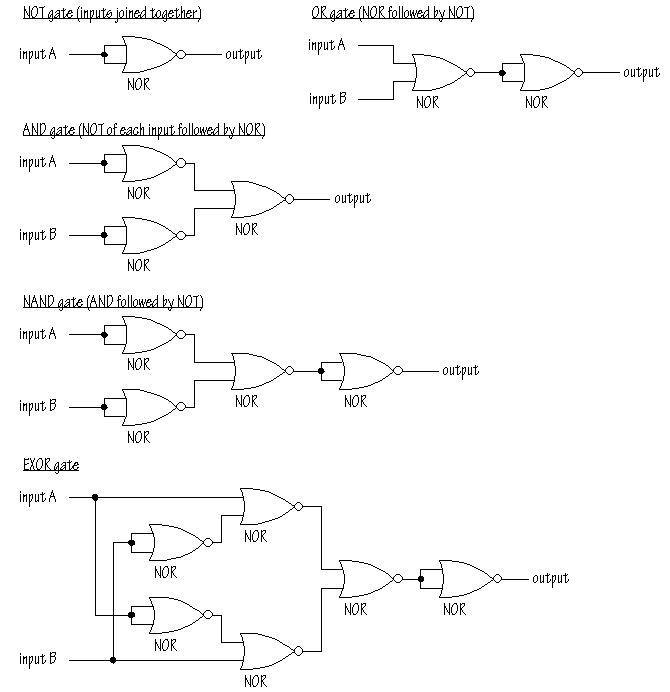
            In this section you should know the truth table and IC numbers of the Basic gates as well Universal Gates(NAND , NOR).Besides this you should also know the XOR and XNOR gates as well as building of all the gates (AND,OR,NOT,XOR,X NOR) using the universal gates(NAND and NOR).


SYMBOL OF BASIC GATES and  TRUTH TABLE:


BASIC GATES USING NAND:


BASIC GATES UISNG NOR


IC 555 :

          This is the most popular IC and the most used among electronic enthusiast.The IC can operate in two basic modes ASTABLE and MONO STABLE mode.In Monosatble mode the IC gives a Single Pulse after a delay set by the values of R and C while in ASTABLE mode it gives a train pulse whose frequency and on-off time is determined by the value of  R and C.

YOU NEED TO KNOW THE PIN-OUT:


555 in ASTABLE MODE:


555 in MONOSTABLE MODE:


IC 741: 

       This is OP-AMP IC.a OP-AMP is operational amplifier which has a variable gain.the IC can be used in two mode as INVERTING AMPLIFIER and the NON-INVERTING AMPLIFIER.


Transistors:

         A transistor is a semiconductor device used to amplify and switch electronic signals and electrical power. It is composed of semiconductor material with at least three terminals for connection to an external circuit. A voltage or current applied to one pair of the transistor's terminals changes the current through another pair of terminals. Because the controlled (output) power can be higher than the controlling (input) power, a transistor can amplify a signal. Today, some transistors are packaged individually, but many more are found embedded in integrated circuits.
The transistor is the fundamental building block of modern electronic devices, and is ubiquitous in modern electronic systems.


Simplified operation


1) Transistor as a switch:


    Transistors are commonly used as electronic switches, both for high-power applications such as switched-mode power supplies and for low-power applications such as logic gates.


     A  switch is a device that is used to 'open' or 'close' a circuit. Opening a circuit means creating a break in the circuit, preventing current flow and thus, turning it 'off'.  Closing a circuit, on the other, means completing the circuit path, thereby allowing current to flow around it and thus, turning it 'on'. When the switch is closed, the transistor goes into saturation, due to which the voltage at the output is zero. When the switch is open, the transistor goes into Cut-off State, as there is no base current. Hence the collector current drops to zero. Now, as there is no current flowing through resistor, the collector voltage rises to the supply voltage (5V) and voltage at the output is 5V.


2) Transistor as an amplifier:

                              The transistor can be used as a Amplifier in various configurations having different gains hand input impedance as well different advantages and dis advantages.The three basic configuration in which it is used as a amplifier is Common Emitter(CE) Common collector(CC) and Common Base(CB)


Monday, 22 December 2014

ARDUINO TUTORIAL FOR BEGINNERS - 2


  Hello,
            
              In the last post we have answered some of the most common Frequently asked Questions(FAQ's) about Arduino's.Hope that now you are ready with the basic setup for starting arduino,lets have a quick look at the requirements

  1. ARDUINO SOFTWARE IDE
  2. ARDUINO BOARD
  3. MOST IMP "SOME INNOVATIVE IDEAS IN YOUR MIND"
   Now that you are ready,Lets get started.

  1.  Open the Arduino IDE on the desktop 
Now lets get into the command icons that you can see on the top left corner of the desktop

      
     COMPILE :If you have done some kind of programming ever than you must have heard this word some where ,a compiler converts the HIGH LEVEL language code into the MACHINE LANGUAGE(HEX file)  which the arduino can understand

You can have a more knowledge on compiler and interpreter from the following link

     UPLOAD :This is used to transfer the code from the PC to the Arduino Board.So the upload is actually two step process in which the code is COMPILED first into the machine language and then BURNED onto the Arduino MCU(by the way arduino UNO uses the ATMEL AVR 328P-PU Micro controller )

rest of the command are self explanatory.


     2.   Now lets Start learning the Arduino "SYNTAX"

Open the "BLINK" example in Arduino the best one to start with!!!!


Lets see what the code has?????


The definition and significance of each line has been explained in the figure above

     3.  Let us list down the important Functions and Key words used in the above code:

  1. "int" :It is a type of variable 
  2. "void" : It is the type of function return,when ever we define a function in any language we need to define the type of value it gives to the output.if the function does give any value in return we name the return type as "VOID" 
  3. "setup":It is the function of Non-return type which runs for one time whenever the arduino is reset or powered.Thus it contains the intinitialization of all the things used in the code.
  4. "pinMode":This is a function which is used to define the behavior of a pin ,the pin can act as either INPUT or OUTPUT.
  5. "loop":This function is operated after the setup function has been run once and then continues to run for infinite time or until the arduino is reset or switched off. Thus it is similar to a while loop in "C"
  6. "digitalWrite":This is a function used to write a digital value (HIGH or LOW and 0 or 1) to any pin initialized in the setup as OUTPUT.    
  7. "delay()": This function is used to produce a delay in the execution of code,this is required when taking input from a sensor in order to provide settling time to the sensor and give new reading.

     4.  Practice Question:

Write a code to blink the LED connected at pin number 3 of Arduino uno and with a ON time of  700 ms and OFF time of 200 ms ?


After you have all of this please watch this video to get the things much more clear.

Tutorial 01 and 02


Saturday, 20 December 2014

ARDUINO TUTORIALS FOR BEGINNERS-I


I have been working with Arduino's for some two years now and have completed many interesting projects using this simple micro-controller Board ,so before i start posting my projects here i would like to post a series of arduino tutorials for those new to the world of this magical device.


"ARDUINO-FAQ'S"

So the first question that many people ask me when they hear about arduino.

 1) What is this ARDUINO????

so the answer is simple---wikipedia says this.
  1. "Arduino is a family of single-board micro controllers, intended to make it easier to build interactive objects or environments. The hardware consists of an open-source hardware board designed around an 8-bit Atmel AVR micro controller or a 32-bit Atmel ARM".
so putting this in simple words,Arduino is a "MICRO-CONTROLLER" that has a Programming Environment (IDE)  provided by the arduino people which is so simple to use that you will never forget it.


So now lets get started!!!

2) What do you require to begin learning arduino?????

  • ARDUINO software ----->get it on the following link                                       http://arduino.cc/en/Main/Software
 
  • A ARDUINO BOARD-----> you can search for store nearby or even order it online arduino is easily available,because it is very much popular and used among developers because of its simplicity.
  • A COMPUTER

  • Very important---"Some innovative ideas in your mind"
That is it,this is all that you need for learning arduino

3) Which Arduino to select??????

      If you are Beginner than the best to start up with is arduino "UNO" it is sufficient for beginners and can be used for complex task as well because this is what i used for most of my project's and the second reason it is "CHEAP" as compared to other arduino boards so not a big issue if yu fry up your new arduino "UNO" 

 
4) What is the Difference between a Micro controller and a Micro processor?????

BRAIN POWER:

    So putting it in simple word's for beginners, A micro controller has low processing power which means it cant process large and complex tasks e.g processing a image, but a micro processor can do very much complex task with ease.

MUSCLE POWER:

      BUT the micro processor  does not sufficient power to drive external devices that is it cant control external devices easily but the micro-controller can do so and thus is named a controller while a processor is called so because of its high processing power.

So your Arduino is a  Micro controller and can drive external devices like a LED,Transistor,MOSFET, and even servo motor but a processor cant.

So in simple words a micro controller has muscle power but has low brain power while a processor is sharp at brain but has low muscle power 
the following video may clear it furthur.


Hope that most of your questions as regards to arduino are solved now and in the next post we will go through the arduino IDE and learn the simple arduino programming SYNTAX.